
History, as it has usually been told, has been about the “great men” and their “great deeds.” However, the women supporting those men are generally ignored by historians. The contributions of these women is at least as significant as those of the men, and perhaps more so, …and needs to be told.
Of course, in earlier days, things were very different for women than they are today. Until the late 1800’s and early 1900’s, women essentially had almost no rights, and their value was about the same as cattle. They were, for all intents and purposes, owned by their father until marriage, and then owned by their husband until death.
Marriages were usually arranged that would best serve the needs of the men involved. A man would seek out a wife who came with property and money from her father – which the new husband would then own upon marriage to the blushing bride.
These women had little to no say in whom they married and when. Women had essentially NO RIGHTS. Anything they owned did not belong to them, it belonged 100 percent to their husband. They were not allowed to vote, and no one (i.e. men) wanted a woman to be involved in any way with business, decision making of any sort, even property ownership. In fact, women were not thought capable of “thinking for themselves” until the late 1800’s and early 1900’s.
White women in Maine finally won the right to vote on September 13, 1920, however, it was not until 1955 when the first Native American woman living on a reservation in Maine was allowed to vote.
Until 1854 in Maine, a woman who happened to earn any wages outside of the home was not entitled to keep them, they belonged entirely to her husband. That year, the Maine State Legislature passed a bill titled, “An Act to Secure to Married Women their Earnings.”
The law read,
“Any married woman, who shall perform personal labor or services, shall be entitled to receive the wages due for the same, to her sole use and benefit, free from all claims of her husband, his assigns, and creditors. Such married women shall have power to collect such wages, and to give receipt thereof; and she may commence and prosecute suits for the recovery of the same, in her own name…”
Of course, the good men of Maine’s legislature also added the following amendment to the bill:
“Provided however, that no husband shall be compelled to pay any costs that may accrue from any action authorized by this act, and that nothing herein contained shall be construed to deprive the husband of his right to the personal services of the wife, when he may require them at home or elsewhere.”
Should a man become tired of his wife from the mid 1800’s to the early 1900’s, there was an easy solution… he could have her committed to a mental hospital, in those days called a “lunatic asylum.” Until the late 1800’s and early 1900’s all it took to commit her was her husband’s say-so. These were essentially prisons, run like prisons, and there was a tremendous amount of abuse of every sort that occurred there. Few women ever got out once committed as a “lunatic.”
Although the challenges and sometimes extreme difficulties and the strength and courage of these early pioneer women allowed for the many steps women have taken forward in Maine and the nation today, there are still giant leaps left to be taken to gain equal footing with the males of our species.
It is to these early strong courageous women pioneers this article is dedicated, with great respect for all that they accomplished as unsung, and often unknown heroes among the builders of Presque Isle and elsewhere.
Two of them to be discussed here, being the first two non-Native American women to live in what has become Presque Isle today. At the time they came here, they were the property of their husbands, however, these two women lived very different lives from each other, as we shall see, yet, their contributions to the history and success of Presque Isle are every bit as important, if not more so, than that of their husbands. Sadly, their stories have largely been ignored by historians of the area. However, their names deserve to be recognized in the annals of the history of Presque Isle – for they were at least as important as their husbands in making Presque Isle what it has become today.
Eunice Beckwith Bull
Eunice was the first woman to come to live in what is today called, Presque Isle, Maine. There were Native American women who also came and went in the region with their families, but due to their migratory lifestyle, they seldom stayed put in one area at that time, and for the most part, sadly we may never know their names.
Eunice Beckwith Bull and her husband Peter Bull were from New Brunswick Canada, as were the vast majority of the earliest settlers in the central Aroostook County region who came after them. They came to what is today called Presque Isle, Maine in 1819, becoming the first setters in the double township.
Peter learned that the New Brunswick, government was giving land grants of 600 acres to anyone who would establish a sawmill in an area without one. This offer included the area well known by everyone at that time to be part of Massachusetts/Maine along the Aroostook River; as well as along the St. John River. The offer included basically all lands in Maine north of Mars Hill Mountain. This was an offer too good to pass up, and the Bull’s moved to what was then Massachusetts, but soon became Maine in 1820.
The reason the government of New Brunswick (England at the time) made this offer was because they had discovered that they had a big problem. The War of 1812 brought the problem to the forefront for them. At that time, the State of Massachusetts, and what would become Maine, and later Aroostook County extended much farther north than it does today – very nearly to the St. Lawrence River. The border had been established by the Treaty of Peace, otherwise called the Treaty of Paris on September 3, 1783.
New Brunswick/England had been in the habit of sending their troops over land, across what became called, “the Grand Communication Route.” This route originated in Halifax, Nova Scotia eventually followed the St. John River and from there went on to Quebec the seat of the English government at the time. Part of it follows nearly the location of the Trans-Canada Highway along the St. John River today.
Following the War of 1812, there were concerns raised by the British Commissioners in Canada about what would happen if the United States decided to stop the flow of troops, mail, and commerce over the “Grand Communication Route.” At first, the Commissioners attempted to negotiate with the United States to buy the land. However, that failed because the United States said that they had no right to sell any land belonging to a State.
After that, on September 14, 1814, the British Commissioners, desperate to take ownership of the Grand Communication Route, made a claim they fully well knew to be false, that all of the land belonging to Massachusetts/Maine above Mars Hill Mountain in today’s Mars Hill, Maine – and from there to the actual border along the Saint Lawrence River, belonged to England.
To test their newly fabricated claims, and to make an effort to control the region for their political and commercial reasons, New Brunswick began issuing land grants in what was clearly the United States territory in both the St. John Valley in present-day Madawaska area; and in present-day central Aroostook County along the Aroostook River. This second area included what would one-day become Presque Isle.
Peter Bull got one of the early land grants and promised to build a saw mill to allow for and encourage settlement of New Brunswick/English subjects from New Brunswick in the area. Peter’s grant was for 600 acres in what would become Presque Isle, providing he also built a sawmill. Peter was a Loyalist, from a family of Loyalists who ended up in New Brunswick from New York State when they lost the Revolutionary War.
With a tow-boat, Peter came up the St. John River as far as the Tobique River near present-day Perth-Andover, New Brunswick. He had his household goods, and his carpenter’s tools and a small amount of machinery that he would need to establish a home and build his sawmill.
Peter was not alone. He brought with him a millwright and six strapping young axe man who would begin harvesting the timber in the region as soon as they arrived.
Along with him, was his wife, Eunice. She was a tall woman, born Eunice Beckwith, also from New Brunswick.
Peter’s land grant was at the mouth of the Presque Isle Stream where it flowed into the Aroostook River, very near where the Aroostook Center Mall is located in present-day Presque Isle.
When the travelers arrived in May of 1819, Peter built a substantial and roomy log cabin on the bank of the Aroostook River below the Presque Isle Stream, about where the bridge on Route 1 near the Aroostook Center Mall crosses the Aroostook River today in Presque Isle.
The cabin taken care of, Peter then began laying out his claim to his 600 acres, which he chose on both sides of the Aroostook River, and extending all the way to the present-day corners of the townships of Mapleton and Chapman.
The next order of business was constructing the sawmill. Amazingly, the men were able to get the work done by Christmas of 1819. The mill was built at the end of the Presque Isle Stream where if flows into the Aroostook River. However, superstitious people said that the mill was built on the wrong time of the moon, and it never did prosper for Peter.
Superstition aside, part of the problem was that there wasn’t much call for sawn lumber at that time along the banks of the Aroostook River in Central Aroostook. The earliest settlers who came after Peter preferred to build log cabins. With money scarce, they simply did not have the means to purchase sawn lumber to build with.
But, being an industrious man, Peter decided that all was not lost… he could use the mill to square up the big Pumpkin Pine logs that were being cut in the forest around the mill. These giant trees were typically cut into squares the length of the tree using the huge sharp broad axes of the time. These squared, tree-length timbers were known as “ton timber.” But it took strong men with strong arms and backs to make ton timber, and Peter thought to save that additional labor by running the trees through his mill to remove the sides and square the trees for market. Being a thrifty man, he also planned to use the sides of the trees to make boards whenever that market became available.
Once “squared” these giants of the forest were then floated down the Aroostook River, and into the St. John, and from there to places like Fredericton, and St. John in present-day New Brunswick to the bigger saw mills, and to the ships waiting to load the timber.
But, Peter had another problem… his mill was built too low, so that unfortunately, the water came up over the floor much of the time, and the mill had to sit idle for periods of time. When the water would finally subside, and go down, it was found that the mill dam was built too low and would not hold enough water to operate the big overshot mill wheel that ran the machinery that powered the mill. As a result, he was only able to operate the mill some of the time, and only for an hour or two at a time due to not enough water from the dam.
Another problem that Peter had was that the timber buyers in Fredericton and St. John believed – rightly or wrongly, that square timber that was sawn instead of hand hewn would fit too snugly together in the holds of the big ships, and would rot before it got to its destination. So, the market for sawn squared timber was not very strong.
As if all of that was not bad enough… the dam blew out and it took Peter a long time and a lot of money to repair it. However, in the mean time, Peter made his living like virtually all of his neighbors who had come after him from New Brunswick, by cutting the big Pumpkin Pines and floating them to the markets in Canada. Essentially, he, like virtually all of his neighbors, made their living from stealing the trees from the State of Maine. Of course, they also had permits and land grants from the New Brunswick/English government allowing them to do so.
It was this theft of Maine’s timber (encouraged and supported by the New Brunswick Government); along with the encroachment of the government of England/New Brunswick into land owned by Maine with the intention of claiming it as their own, that would lead ultimately to the Aroostook War in 1839.
By 1824, in addition to building his mill, Peter had also cleared land and built a farm, again, as most of the settlers at that time were doing. More and more people were arriving from New Brunswick because of the very lucrative trade in the solen timber growing on Aroostook County soil that was being cut and floated to market in New Brunswick on the rivers.
Peter, however, found that he was not even able to sell any of his land because the New Brunswick government knew that they had no right to make those land grants in Maine, and the land grants that they had issued essentially became worthless. But, Peter stayed on, as did many of the other families, becoming a United States citizen by virtue of the Webster-Ashburton Treaty of 1842 that settled the Aroostook War. Many of he and Eunice’s heirs still reside in the area today.
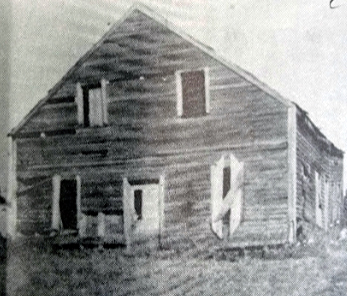
After the failure of his mill, Peter eventually moved his family up river becoming the first settlers in what became Mapleton, where he built a home of sawed timber, and put plaster inside on the walls – a real palace in the area in its day, and the first home built of sawn lumber on the banks of the Aroostook River at that time.
A picture of the frame house Peter Bull and Eunice built on the banks of the Aroostook River in Mapleton - as it looked in 1965. It was the first frame house built in this area.
Peter’s wife, Eunice, had arrived on the banks of the Aroostook River with him in 1819, and no doubt worked just as hard as he did in building their new life. However, history does not record the stories of females ordinarily, and thus, we have very little information about her.
We do, however have the following story.
Before Christmas, in 1819, Eunice returned home to New Brunswick, where she gave birth to their first child, a daughter, Nancy Bull. That next spring in 1820, Eunice returned to Presque Isle with baby Nancy – the first of a total of 14 children that Eunice gave birth to during her lifetime.
In a yellowed and tattered newspaper clipping (probably from the Bangor Daily Commercial) carefully preserved in the family Bible by the Bull family today, titled, “Mrs. Eunice Bull One of Maine’s Heroic Pioneers; Faced Dangers of Wilderness, the writer had this to say about Eunice:
“A story as thrilling as any concerned with the deeds and heroic struggles of the pioneers who paved the way for civilization in the west in the days of the Indians, buffalos, etc., was found in a newspaper clipping in memoriam to Mrs. Eunice Beckwith Bull, who died in Mapleton on May 7, 1891, which was brought to the Commercial this week by one of her grandsons, W. W. Bull.
Part of the clipping follows:
Mrs. Bull was the oldest of a family of three sisters and one brother. Her parents came from Nova Scotia when young people, and settled in Majorfield, N. B. where she was born. She was married in Chatham, Mirimichi, when 16 years old, making one of a triple wedding – her two sisters being married at the same time.
She came to Aroostook about 1819, and at that time, her family home was the only settlement near the Aroostook Bridge at Presque Isle. When tired of riding in the boat, she would take her baby to her arms and walk along the shores.
For three months she did not hear another woman’s voice; then a Native American woman came down the river, singing as she paddled her canoe, and Mrs. Bull often said that song was the sweetest music she ever heard.
She was a woman of rare forethought and energy. At one time when her husband was away in the logging camp, a very heavy snow storm came on. The most of the hay was in a barn upon an island, while a newer stronger structure stood upon the mainland. With the aid of two small boys and a yoke of oxen she moved the hay, and, as she came up the bank with the last load, the barn on the island crashed in with the weight of the snow.
At the time she came to Aroostook, all trading had to be done at Woodstock, N. B. There were no stores, no mills, no post offices nearer. Once she had a very narrow escape in the rips below Aroostook Falls. She was going to Woodstock, with wool to card, and grain to grind, in company with a neighbor. She had a young baby with her, which, as it was near evening, she had wrapped in a heavy cloak, and that saved its life when the boat upset, for it kept the child from sinking.
Mrs. Bull was wedged between the boat and the rocks, in such a way that the waves kept dashing over her, while the force of the current pushed the boat so hard against her that it required the strength of three men to hold it back so that she could be pulled out.
She was unconscious, but the first words she said on recovering were, ‘Where is my baby?’ That baby was Mrs. Wilder Stratton, now living in Presque Isle, and it happened 64 years ago in June. She reached Woodstock safely, but she lost everything in the boat, and her body was black and blue for days.
Mrs. Bull died at the age of 80 years in 1891. Her life was filled with unselfish, loving acts of kindness, and although she was not in the habit of making frequent visits, those who knew her best will remember her worth and cherish her memory.
She had 14 children, eight of whom are still living, and 50 grandchildren. There are many great great grandchildren now living in the vicinity of Bangor.”
Unlike his neighbor Dennis Fairbanks, as we shall see, Peter Bull very much cherished and loved Eunice. In a newspaper clipping from the Presque Isle Star-Herald of November 15, 1934, a story is told about Peter climbing Haystack Mountain in Castle Hill, nearby his home on the Aroostook River:
“…One day Peter Bull stood on the summit of old Haystack evidently Peter Bull loved his wife whose name was Eunice. I have never been told why she was not with him that day… But as he stood on Haystack he exclaimed, ‘Oh, Lord, how I wish Eunice was here. I can see all God’s Creation and Houlton and Woodstock besides.’”
Although the author of the article is not identified, she goes on to say:
“When I was a small girl I heard my mother tell this story and about two years ago the same was printed in an article in the Bangor Daily Commercial. This is the story: Eunice Bull had heard her husband’s voice and the voices of her children but for a long period of time she had not heard the voice of another woman. On day an Indian woman came paddling down the river in her little birch bark canoe singing, and Eunice Bull told her friends many years later that it was the sweetest music she ever heard, the sound of another woman’s voice…”
It would be fascinating to learn more of Eunice Beckwith Bull’s story. She and her husband Peter, lie buried side-by-side in the Johnson Cemetery in Presque Isle, land which once belonged to them by virtue of a land grant from the New Brunswick government. While Peter has a grave stone, Eunice does not.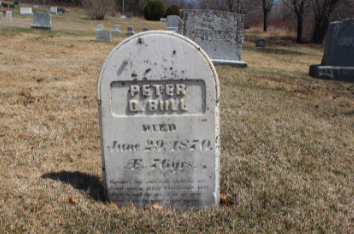
Hannah Foster Fairbanks
Just a short distance up the hill at Johnson Cemetery, lies the second woman to arrive in what would become Presque Isle, Hannah Foster Fairbanks. Like Eunice, Hannah’s grave is unmarked.
While Peter and Eunice were the first settlers in the north half of the double-township of present-day Presque Isle, and the first in the entire township, arriving in 1819; Dennis and Hannah were the first settlers in the south half of the double-township, arriving in 1828. The two men were rivals, and at times, bitter enemies, and at other times, good friends, it depended upon the circumstances at the time, and the mood that Dennis may have been in. History provides no hints about the relationship the wives had with each other.
Dennis Fairbanks, like Peter Bull before him, had arrived with a large land grant, but his was from the United States. It had the same conditions,… that he build a sawmill. The reasons for the land grant were the same… to encourage settlement of the area that New Brunswick was now claiming as their own. Land grant in hand, Dennis and Hannah arrived in what would become Presque Isle in 1828 from Winthrop, Maine.
According to Sidney Cook, writing in 1902, when Dennis Fairbanks first arrived in Aroostook County, he found that the best spot for a mill at the mouth of the Presque Isle Stream had been already taken up by Peter Bull. Dennis tried to buy Peter out but Peter refused to sell. Dennis then moved upstream on the Presque Isle Stream (about where the State Street Bridge now crosses the Presque Isle Stream) and built a dam that negatively impacted the water flowing to Peter’s mill. “Thus began a bitter struggle to get the mastery by inducing newcomers to settle above the two mills, thereby locating the coming village (of Presque Isle). Fairbanks possessed a belligerent disposition, and not only welcomed a contest, but gloried in it.”
It is for this reason, according to earlier historians, that the village of Presque Isle was located where it is today, rather than at the mouth of the Presque Isle Stream where Peter Bull had located, and where Dennis wanted to build his new town. Peter’s mill ultimately failed as a result of many issues, including the impacts Dennis’s mill had on water levels needed to operate the mill. As mentioned above, Peter moved upriver to Mapleton after his mill failed.
In spite of their bitter rivalry, Dennis assisted Peter when, just as the Aroostook War was about to begin, on February 11, 1839, the Posse under Sheriff Strickland came down the Aroostook River (which was the highway at that time during the winter) from Masardis and reached Presque Isle. There they were met by between ten and sixteen armed men standing across the river blocking their way so that two of their fellow lumbermen from New Brunswick could escape the posse and avoid being arrested for timber theft. Sheriff Strickland rode his horse through the line of men in an effort to capture the escaping men. As he did so, one of the men in the line fired at Strickland and injured his horse (which only received a minor flesh wound and did not die).
Sheriff Strickland and the posse captured the escaping men, and arrested the other men on the ice. It was this incident and the hostilities surrounding it which ultimately sparked the State of Maine to declare war against England and the Aroostook War got under way. It is the first and only time a State ever declared war against another country; and the third time the United States and England entered into a war.
After the arrests and the subsequent capture of the Land Agent by the New Brunswick lumbermen, Strickland set off on his infamous ride to Augusta that later became the subject of many songs and verses of the day. This ride, although far less known in history, has been compared by some historians to the famous ride of Paul Revere. Strickland stopped only to change horses as he raced toward Augusta following these fateful events.
On the ice of the Aroostook River that February day, the posse arrested the lumbermen and some were ultimately released while five of them were taken to Bangor to jail and their horse teams were confiscated. Peter Bull was one of the individuals who was arrested on the ice for timber theft. Dennis Fairbanks (who was neither a member of the posse nor a member of the group of lumbermen blocking the river) and Ebenezer Webster (who had arrived with the posse) posted bail for Peter, but, interestingly, not for any of the other men.
As the youngest child of a prominent family, Dennis had some strong role models, and it is clear he tried to emulate his father and brother with his own life when he came to Aroostook County to establish the town of Fairbanks (now Presque Isle). Like his family before him, Dennis was an active and energetic citizen of the new community he developed.
Dennis was actively involved in government and served one term as a Legislator from Aroostook County in 1843. He also served as a Justice of the Peace. He ran a mercantile store from his lumber mill and was known to be very generous at times with individuals who were in need. He built and ran a lumber mill and a grist mill serving the area. The Aroostook War was a major boon to his business interests and he provided lumber, rations, accommodations, supplies, and much more to the troops when they were here.
In 1844 the first school in Presque Isle was held in his grist mill and was taught by Alice Wheeler, who was the daughter of Mr. Wheeler the mill operator at that time. Town meetings and voting also took place in his mill in some years.
Dennis and his wife Hannah with their six children first lived briefly in part of the sawmill Dennis built along the banks of the Presque Isle Stream located on the north side of where the State Street bridge crosses the river today. Subsequently, Dennis built a home nearby.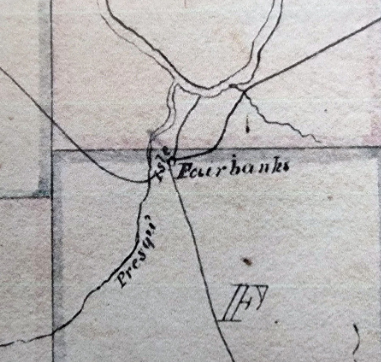
From: 1839 Charles Jarvis Map. Maine State Archives. This map shows the Presque Isle Stream, as well as the location where the Presque Isle Stream empties in to the Aroostook River - where Peter Bull first built his sawmill. It also shows where the village known as “Fairbanks” was located at that time.
As much as Dennis was civic minded and could be extremely generous, he also had a well-known violent streak. As Dale Steinhaur said of Dennis in 1984, “for the early citizens of Presque Isle, Dennis Fairbanks appears to have been ‘the skeleton in the cupboard.’”
In fact, it was Dennis’s sometimes violent temper that gave Caribou one of their early leading citizens, Washington Vaughan. Dennis and Washington had been partners in building the mills in Presque Isle, but, according to Sidney Cook, Dennis wanted to be rid of his partner after the mills were built. He “engaged Vaughan in a dispute,” which led to Dennis taking a piece of lumber and hitting Washington over the head with it. Washington’s head was laid open from the blow which nearly killed him, and disabled him for a long period of time. He carried the scar from the assault for the rest of his life. At that point, he moved on to Caribou and split up his partnership with Dennis.
In describing Dennis in 1909, W. T. Ashby wrote, “Fairbanks was educated, suave, smiling, handsome, and diplomatic; that was one side of him. He was also, when he chose to be, stubborn, revengeful, tantalizing, aggressive and treacherous….”
Ashby went on to say that “Dennis Fairbanks was a businessman and a scholar, and was prospering beyond his expectations, and had it not been for his hasty temper and his love of women, the town of Presque Isle would have today been called Fairbanks, and he might have lived and died a respectable citizen, while his remains might have reposed in American soil, under the Stars and Stripes in the town which he founded… instead, he died poor in another country, …while his resting place is unmarked and almost unknown.”
In 1846 when Dennis was fifty-six years old, he got his sixteen-year-old housekeeper, Abigail Bradley, pregnant. On May 15, 1846 he arranged for a lawyer in Fort Fairfield named John Trafton, to sell very nearly all of his property with the exception of a horse, a single-horse wagon and harness, a single sleigh and harness, a saddle and bridle.
Dennis and Abigail and their baby moved to a hotel he either built or purchased located about where the border crossing is now located between Fort Fairfield and New Brunswick. The structure was built so that half of it was on each side of the border. Dennis operated it as a hotel or tavern for several years. He continued to vote in elections in Presque Isle through 1847. Dennis claimed in March or April of 1847 that he had married Abigail in Canada, although his divorce from Hannah was still pending at the time.
On March 10, 1846, Dennis’s wife Hannah filed for divorce. Divorce was unthinkable at that time and seldom did any wife apply for one no matter how bad her marriage was. However Hannah was granted her divorce in July of 1847 and the court gave it an effective date of May 14, 1846, the day BEFORE Dennis transferred his property to his lawyer Mr. Trafton.
In the divorce Hannah said that, “…Dennis, neglecting his marriage vows and duty since said marriage, on or about the fifteenth day of September, in the year of our Lord one thousand, eight hundred and thirty-two, and in divers other days and times between said fifteenth day of September, and the present time has been guilty of extreme cruelty toward your said libellant – and he has repeatedly struck and knocked her down with his fists – has beaten her in the face – has kicked and choked her, so that your libellant has been seriously injured by reason of said blows and kicks; that she has been confined to her bed more than once on account of the violence and injuries inflicted upon her by said Dennis; that she is afraid to live with said Dennis – that he has frequently within the last year, threatened to kill her – and your said libellant firmly believes, that if compelled to live with said Dennis, she has no security for life or limb… Wherefore, your libellant prays that for reason of extreme cruelty and abuse, a divorce… be granted her from said Dennis…”
In the divorce proceedings there were witnesses who testified about Dennis and Hannah. Holmes Daggett of Houlton as Deputy Sheriff in March or April of 1847 testified that he had a conversation with Dennis in Presque Isle and that Dennis said “he should never live again with his wife meaning said Hannah – that he had married “Abigal” meaning as I understood one Abigail Bradley – he further stated that she was then boarding at the house of one Fitzherbert on the British side of the line…” Daggett said Dennis invited him to go to Fitzherbert’s which he did and said he saw Abigail there with a child which she told him was Dennis’s. Dennis, who was also there, said it was his child and said that he and Abigail were married on the British side of the line. Daggett also said, “…the general reputation of said Fairbanks is that of a quarrelsome and violent man, that in my opinion it would not be safe for his wife meaning said Hannah to live with him.”
Hannah’s daughter, also named Hannah, provided a sworn statement dated June 21, 1847 in the divorce proceedings. She described, “…fourteen years since {1833} my Father beat my mother in brutal manner – choked her and put his knees on her stomach which disabled her for a number of days – seven years since {1840} I saw said Fairbanks cuff said Hannah and throw her on the floor which caused the blood … to run from her nose and ears and that same time said he would kill her, he put her in an upper room and kept her there for a week and her food was took to her during that time and since the above time I have seen Dennis cuff choke and strike said Hannah with such power that there were marks left on her person that could be seen for two or three days.”
There were other witnesses too, including Malachi Doyle, Sheriff of Aroostook County, who provided testimony about Dennis’s abuse of Hannah, and added, “I can and do state further that said Fairbanks character and general reputation is that of a violent and abusive man.”
There is no evidence that Dennis fought the divorce. And, in fact, he didn’t appear at the hearing to contest it.
Hannah had asked the judge not only to grant her a divorce, but to also restore the property Dennis had transferred to others back to her because she said the money to acquire it had come from her inheritance when her father died. The court did that and ultimately Hannah was able to re-sell the property, including the sawmill and homes, and provided an income for herself and her children through the deeds of sale on the properties, which included an annual allowance to be paid to her from the purchasers, in addition to the purchase price for the properties.
She moved to Wisconsin a few years later to live with one of her sons. Later still, she returned to Presque Isle and lived with Columbus Hayford on the Caribou Road until she died on January 19, 1876. It is believed she is buried in an unmarked grave, near her young grandson at Johnson Cemetery in Presque Isle.
Dennis and Abigail moved to a farm in Artherette, New Brunswick after a few years living in the US/New Brunswick border area. They had eight children, making, with Dennis’s six children with Hannah, a total of fourteen children for Dennis. Dennis died November 3, 1867 in New Brunswick at about 80 years of age.
There are no markers on Dennis’s grave, which is said to be along the banks of the Tobique River in Artherette. No one can be located today who knows where it is. Abigail moved to Clare, Michigan and remarried twice after Dennis died. She is buried in the Cherry Grove Cemetery in Clare, Michigan.
There are no known photographs of Dennis or Hannah, if any were ever taken of them. However, Dennis’s (and certainly Hannah’s) influence and importance to early Aroostook County was tremendous, and can still be seen in the County today. For example, Dennis laid out many of the major streets in Presque Isle village as they still are currently arranged, and he built the first bridge across the Presque Isle stream – in the same location as the current bridge is now located on present day State Street. His mills furnished food and lumber for the builders of early Aroostook and supplied the troops during the Aroostook War. Although the town does not carry his name, it certainly carries the huge influences this “skeleton in Aroostook’s closet” had on the area.
However, without the money that Hannah inherited from her father, Dennis would not have been able to do any of this. Based upon how she handled her divorce, and subsequently provided an income for herself for the rest of her life from the sale of the properties following the divorce, it is not hard to imagine that Hannah herself may well have been the brains behind Dennis’s brawn. The strength and courage she exhibited in the face of the extreme abuse by her husband at a time when women had virtually no rights, speaks volumes about who she was. For a woman of her time to ultimately survive such incredible abuse, and ultimately stand up for herself demonstrates just how intelligent, and what a remarkable a woman she really was.
These two women, Eunice Beckwith Bull, and Hannah Foster Fairbanks, both buried in unmarked graves not far from each other, deserve to remain names that future generations know well as the important builders and “first ladies” of Presque Isle.